


There is a quiet, endless conversation happening within every human being — a dialogue so constant that most people no longer notice it. It is the dialogue between what they think and what they feel. Sometimes the mind speaks first, and emotion follows. Other times, the emotion rises before the mind can find words.
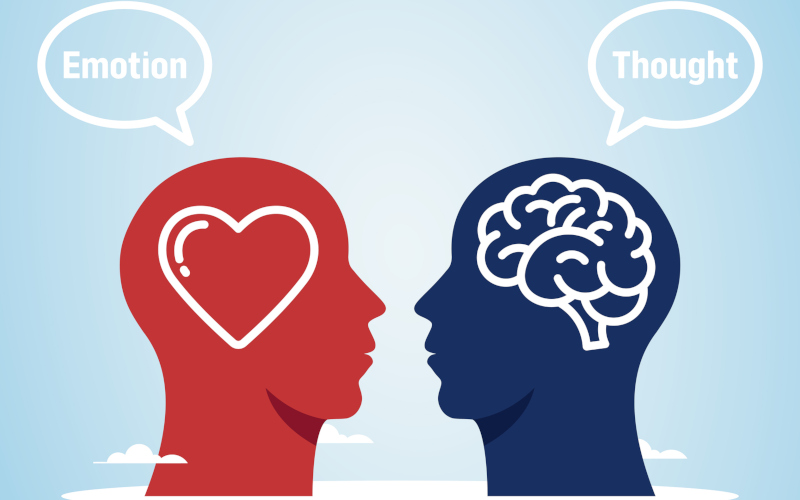
It is not easy to know which one leads. Thought appears rational, measurable, logical. Feeling appears wild, mysterious, wordless. Yet, beneath the surface, they are woven together so tightly that trying to separate them completely is like trying to separate light from heat.
Still, the question remains: Which comes first — the thought or the feeling? And, more importantly, which one controls a person’s life?
The Invisible Chain Between Thought and Feeling
Every thought carries an emotional echo. Every emotion produces a thought in its image. When the mind imagines danger, the body feels fear. When the body feels fear, the mind searches for reasons to justify it.
It is a loop — circular, self-sustaining, endlessly feeding itself. Thought becomes feeling; feeling becomes thought; the two build a world around the person who experiences them.
So when someone says, “I can’t stop thinking like this,” what they often mean is, “I can’t stop feeling like this.” And when they say, “I can’t stop feeling this way,” what they often mean is, “My mind won’t let me think otherwise.”
The truth is that thought and feeling do not exist in isolation. They dance — and whoever leads the dance depends on the level of awareness.
When awareness is low, feeling leads. When awareness is high, thought can guide.
But neither is the enemy. The real question is whether the person is aware of the dance at all.
When Feelings Come First
The body is ancient. Older than language. Older than logic. Older than the mind’s ability to form a sentence. When something happens — a sound, a glance, a memory, a silence — the body reacts before the conscious mind even understands why.
This is why a person can feel sadness without knowing its cause. Why anxiety can rise without a clear reason. Why love can appear suddenly, irrationally, without analysis or permission.
Emotion is the body’s way of speaking before the intellect catches up. It comes from the subconscious, from the parts of experience stored beyond words.
Imagine walking into a room where someone once broke your heart. You may smile and act composed, but your chest tightens. Your body remembers. Your subconscious whispers before thought has time to form.
In this way, feelings are the first messengers of truth. They reveal what the conscious mind tries to hide.
But when emotion rules entirely, the person becomes reactive — a captive of impulses, memories, and invisible wounds. They live not in the present, but in the emotional shadows of the past.
When Thoughts Take the Lead
Thought, on the other hand, can become a tyrant — always analyzing, measuring, predicting. It seeks control because it fears uncertainty.
The mind can create entire storms from a single imagined outcome. It can replay conversations, build futures that have not happened, and assign meaning to events that never carried any.
A single thought — “What if?”— can awaken a thousand emotions. What if I fail? What if I’m not enough? What if they leave? What if it’s too late?
Each “what if” plants a seed of emotion, and emotion waters the seed until it grows into reality inside the nervous system.
This is how people live inside stories that do not exist — thoughts repeated so often that the body begins to treat them as truth.
And yet, thought is not the enemy either. It is a tool, a structure, a bridge. When used consciously, it helps the person step back from emotion and choose a new direction. But when it runs unchecked, it traps them in a cage made of their own predictions.
The Conflict Between the Two
The inner conflict between thought and feeling is the oldest war in the human heart. Feeling says, “This is how it is.” Thought says, “This is how it should be.”
One is raw and honest. The other is calculated and afraid.
When they are at odds, the person feels torn. They act with hesitation, love with fear, speak with doubt. Their body wants one thing; their mind argues for another.
This is what it means to live divided — to move through life with the brakes on, never fully trusting either the logic that explains everything or the feeling that explains nothing.
Peace begins the moment thought and feeling stop fighting and begin to listen to each other instead.
by Cassian Elwood